North Carolina Representation: Why Accountability, Public Safety, and Verification Matter

North Carolina has always been a state built on representation.
From the earliest days of the Mecklenburg Resolves to modern-day legislative debates, the idea that the people deserve a voice has been deeply rooted in our identity. But in today’s climate, that concept feels more complicated than ever.
Because the real question isn’t just:
Do we have representation?
It’s: Who is actually being represented?

A State Built on a Voice
North Carolina’s history is grounded in standing up and speaking out.
The dates on our state flag May 20, 1775 and April 12, 1776 represent moments where North Carolinians didn’t wait for direction. They acted. They made their voices heard.
Representation wasn’t something given.
It was something claimed.
And that mindset helped shape the systems we rely on today... including a justice system built on balance, accountability, and structure.
The Shift in Modern Representation
Fast forward to today, and the landscape looks very different.
There are more voices than ever:
Advocacy groups
Political organizations
Media outlets
Social platforms
But volume doesn’t equal clarity.
In many cases, representation has shifted away from the everyday person... the family trying to navigate the system, the individual sitting in jail awaiting court, the victim seeking justice, and the communities impacted by crime.
Instead, conversations are often driven by:
Funding
Influence
Narrative control
And when that happens, reality can get lost.
Representation in the Justice System
Nowhere is this more visible than in conversations around the criminal justice system.
There’s a growing tendency to simplify complex issues or to frame them in ways that gain attention rather than reflect reality.
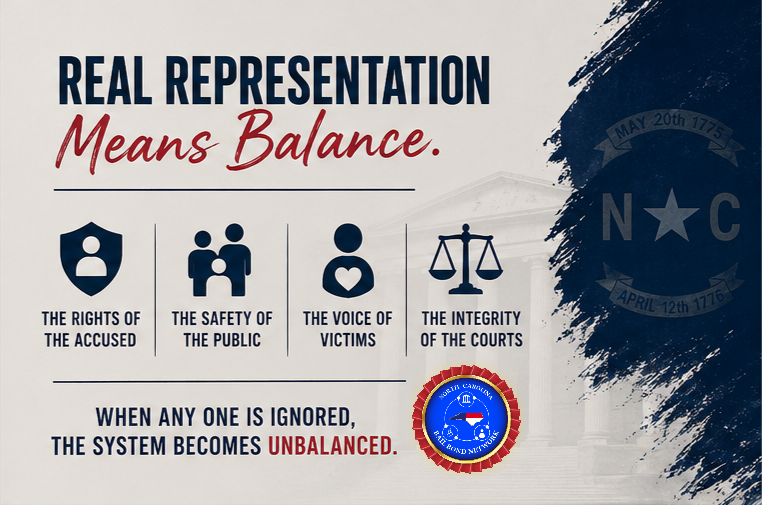
But real representation requires balance:
The rights of the accused
The safety of the public
The voice of victims
The integrity of the courts
When any one of these is ignored, the system becomes unbalanced.
And when the system becomes unbalanced, trust begins to erode.

Real-Life Consequences of Bad Policy in North Carolina
It’s easy to debate policy from a distance.
It’s much harder to face the consequences when those policies play out in real life.
Across North Carolina, decisions made in legislative rooms don’t stay theoretical. They show up in real situations involving real people, families, victims, and entire communities.
When policies are rushed, oversimplified, or driven by incomplete narratives:
Victims can feel overlooked or unprotected
Communities can face increased uncertainty
Accountability within the system begins to weaken
And perhaps most importantly, public trust begins to break down.
Because when outcomes don’t match what people were promised, confidence in representation disappears.
True representation requires more than advocacy.
It requires responsibility for the outcome.
Why Local Representation in North Carolina Matters
North Carolina isn’t one-size-fits-all.
What works in Charlotte may not work in Sylva. What affects Asheville may not reflect reality in Lillington.
That’s why local representation matters.
It matters to have professionals who:
Understand the counties they serve
Know the courts, procedures, and expectations
Are physically present in the communities they represent
Real representation isn’t distant.
It’s local. It’s accessible. It’s accountable.
The Role of Industry Professionals in North Carolina Representation
There is also a layer of representation that often goes overlooked... the professionals working inside the system every day.
These are the individuals who:
See how policies play out in real time
Work directly with families navigating urgent situations
Understand the difference between theory and reality
Their perspective matters because it’s grounded in experience, not headlines.
And in North Carolina, more of these voices are stepping forward to help shape the conversation in a way that reflects what is actually happening on the ground.
The Danger of Bail Scams in North Carolina
In high-stress situations, people don’t always have the time or clarity to question what they’re being told.
That’s exactly what makes them vulnerable.
Across North Carolina, there has been a growing issue:
Individuals posing as bail professionals
Scammers requesting payment under false pretenses
Families are being misled during urgent situations
When misinformation meets urgency, bad decisions can happen fast.
And unfortunately, by the time someone realizes something is wrong, the damage has often already been done.

Verify Before You Pay in North Carolina
That’s why one of the most important standards gaining traction is simple:
Verify before you pay.
This isn’t just advice... It’s protection.
Before making any payment, the public should:
Confirm the identity of the person they are speaking with
Verify licensing through official North Carolina resources
Ensure the business has a legitimate and traceable presence
Legitimate professionals don’t avoid verification.
They encourage it.
Because transparency is part of accountability.
And accountability is part of real representation.
A Growing Movement to Protect the Public
Across North Carolina, there is a growing effort to make verification the standard... not the exception.
Not for competition.
Not for recognition.
But because the risks of inaction are too high.
Professionals across the industry are seeing the same patterns:
Families being taken advantage of
Money being lost to scams
Confusion replacing clarity
And instead of staying silent, more voices are stepping forward.
This is what real representation looks like:
Identifying a problem
Taking responsibility
Providing real solutions
Representation Requires Accountability
Representation doesn’t stop at having a voice.
It requires accountability.
Accountability to:
The public
The system
The outcomes that affect real lives
North Carolina has never been a state that backs down from difficult conversations.
But those conversations must be grounded in reality... not just narrative.
Looking Forward: Representation That Reflects Reality
North Carolina’s future depends on returning to what representation was always meant to be:
Real.
Not driven by trends. Not shaped by outside influence. Not disconnected from consequences.
But grounded in truth, accountability, and public safety.
Because when representation reflects reality... the system works the way it was intended to.
Final Thought
North Carolina doesn’t need more noise.
It needs stronger voices. Clearer direction. And a commitment to protecting the people behind every situation.
Because representation isn’t about who speaks the loudest.
It’s about who stands behind what they say... and who ensures the public is not just heard, but protected.


Comments